Wheel flop explained
Understanding a less known parameter in bike design.
Updated Aug 1st, 2026
Understanding a less known parameter in bike design.
Updated Aug 1st, 2026
Article updated Aug 1st, 2026: section Background: Steering a Bicycle
Why does it matter?
How good a bike rides is largely driven by its steering characteristics, by the feeling you have while riding a straight line or around bends. Wheel flop has a big influence here, but the parameter is rarely discussed, compared to head tube angle or trail.
So, what is wheel flop then?
I came across the term on Peter Verdone’s website where you can find profound information about frame building and bike design. Interestingly, a quick web search failed to deliver a coherent definition, instead you find contradictory information and emotional discussion.
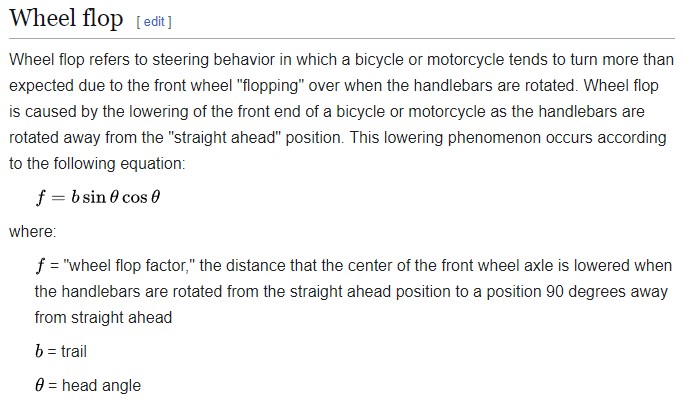
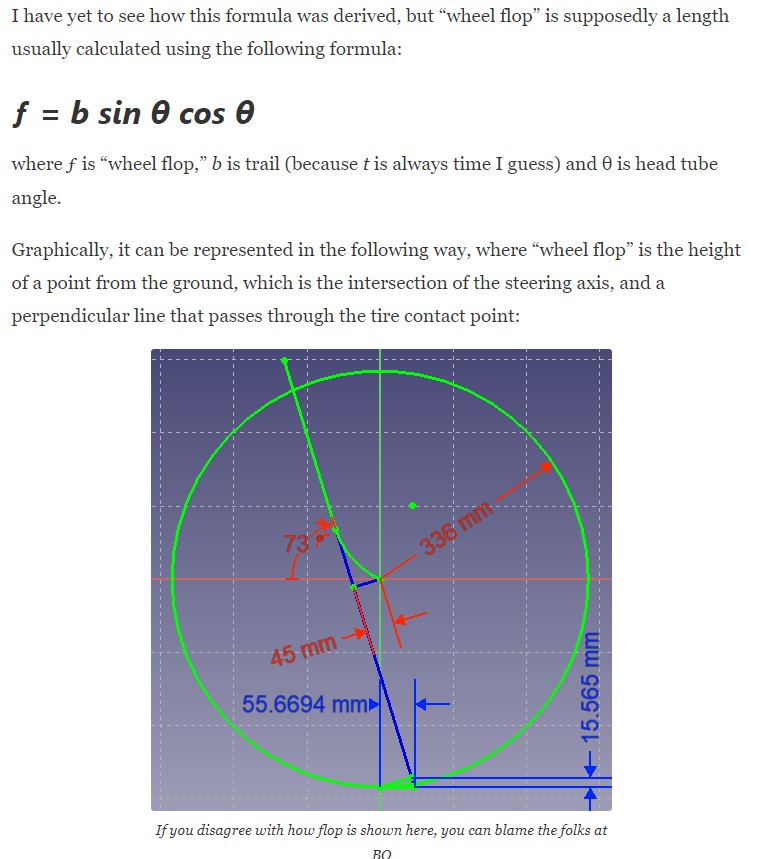
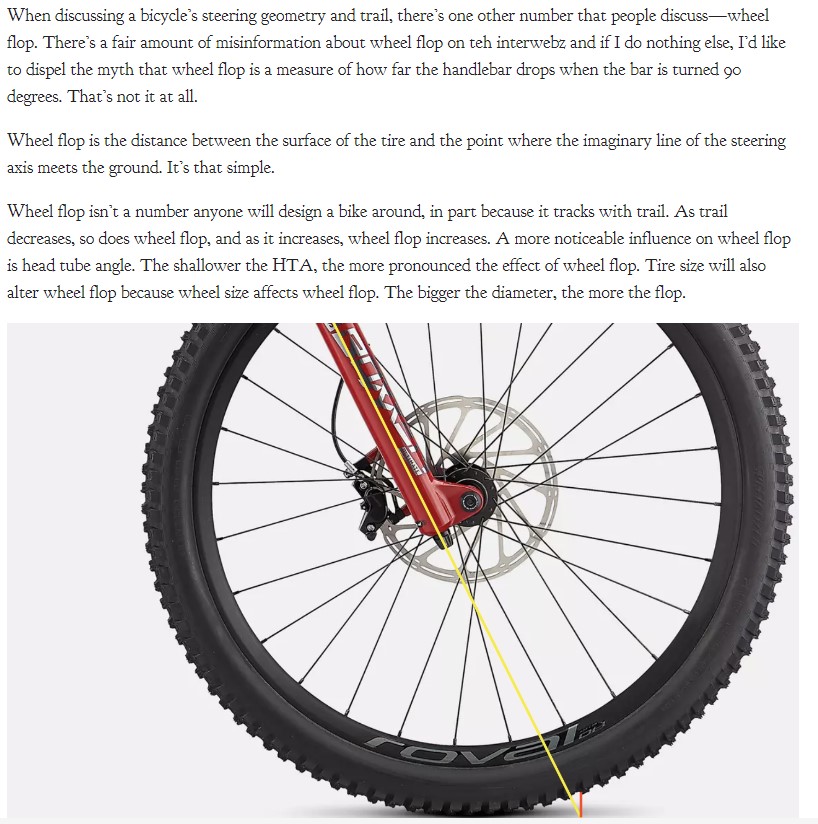
Ok, folks. The formula in Wikipedia does not match the verbal definition given there. The Kuromori blog article builds on said formula, but debates its actual significance, and Bicycle Independent come up with their own definition, claiming "misinformation" in other sources.
I started myself. For me, wheel flop is a geometric dimension that influences the steering characteristics of a bike. When you turn the handlebar, the front of the bike will lower. The weight on the front then translates into a torque towards increased steering angle, which can feel that the the front wheel wants to "flop" from one side to the other.
It is quite easy to determine the lowering distance in mm when the steering is turned by 90° in a graphic solution, e.g. in a 2D CAD drawing. (I also went through a numeric solution, which involves a bit more trigonometry than you might expect at a first glance).
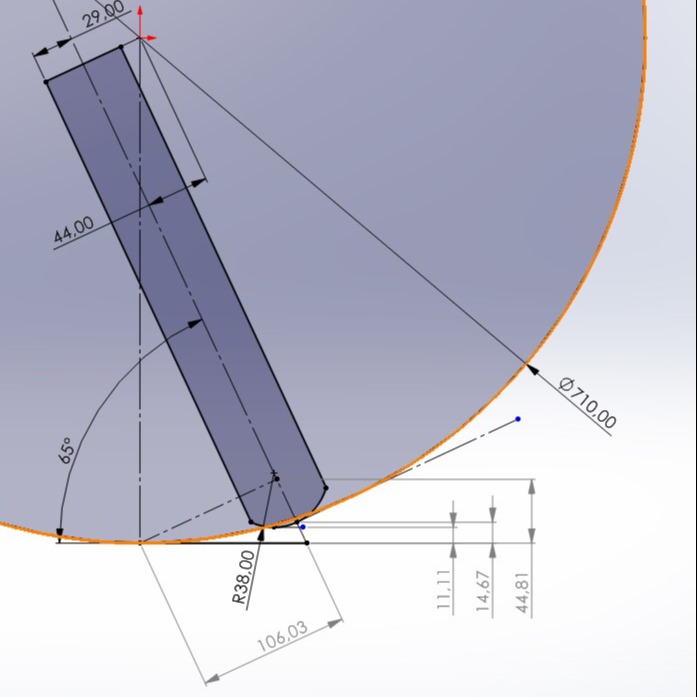
On the other hand, the result of the formula above is indeed also a vertical distance - unfortunately a different one, as you can see in this drawing.
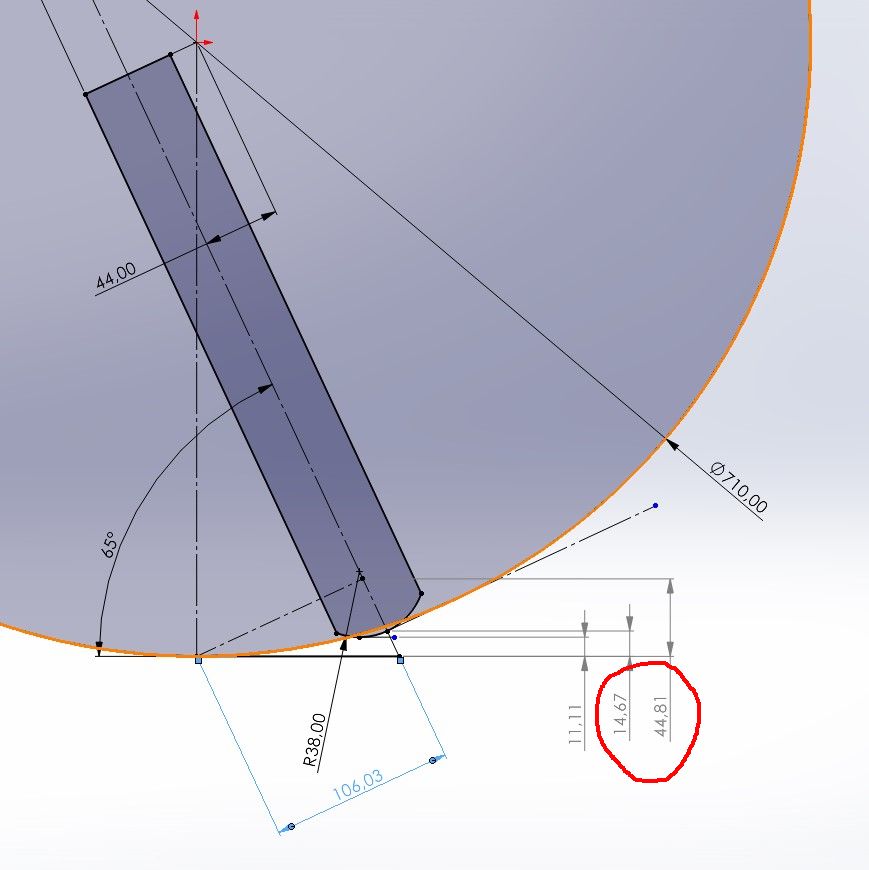
These two wildly different dimensions could be called wheel flop factor/distance/... whatever. Both are related to the lowering of the bike's front when turning the handlebar.
Let us give them working titles:
Classic wheel flop - as calculated by the formula, here 44.81mm
90° wheel flop - as measured for the fork turned by 90° (using the actual tire profile), here 14.67mm
This does not look good. We want to have one catchy parameter that gives us a good idea how "floppy" a bike will ride - now we have two that differ a lot.
Background: Steering a Bicycle
At this point, a few thoughts on the basics of steering a bicycle and how it might feel. Take these as my personal insights, not as bullet-proof findings.
How can we ride a bike, anyway? We balance on those two tiny contact patches and should tip over all the time, right?
Essentially, we keep aligning those contact points with our center of gravity. We do this by little weight shifts, by slightly leaning the bike, and by steering. When the contact points are vertical underneath, we will stay upright and ride a straight line. When they move out to one side (intentionally or not), we follow a curved path (or we fall over).
Let us assume that:
- we move in a straight line
- the bike starts to lean to one side
With no centrifugal force present, the force on the contact patch is still vertical:
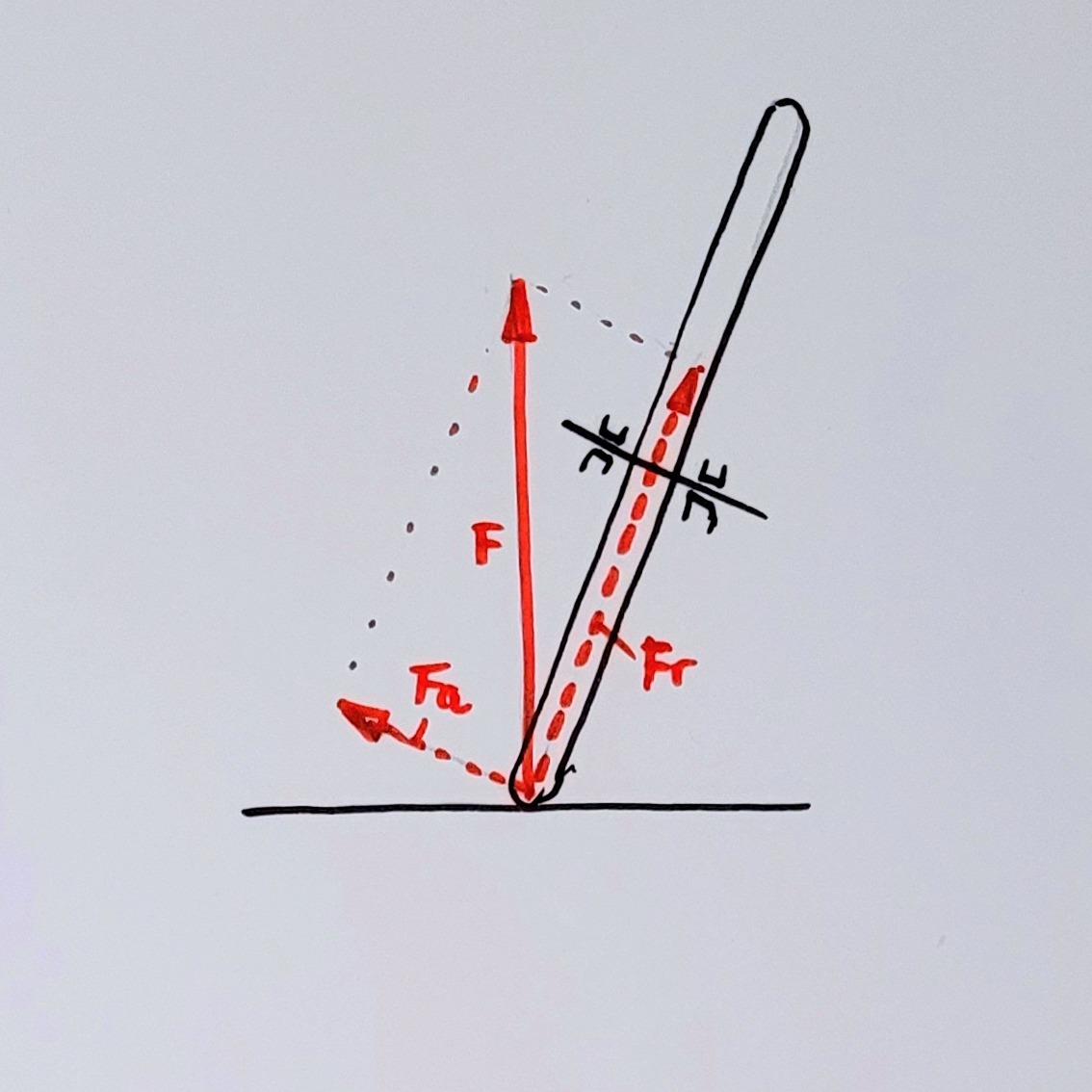
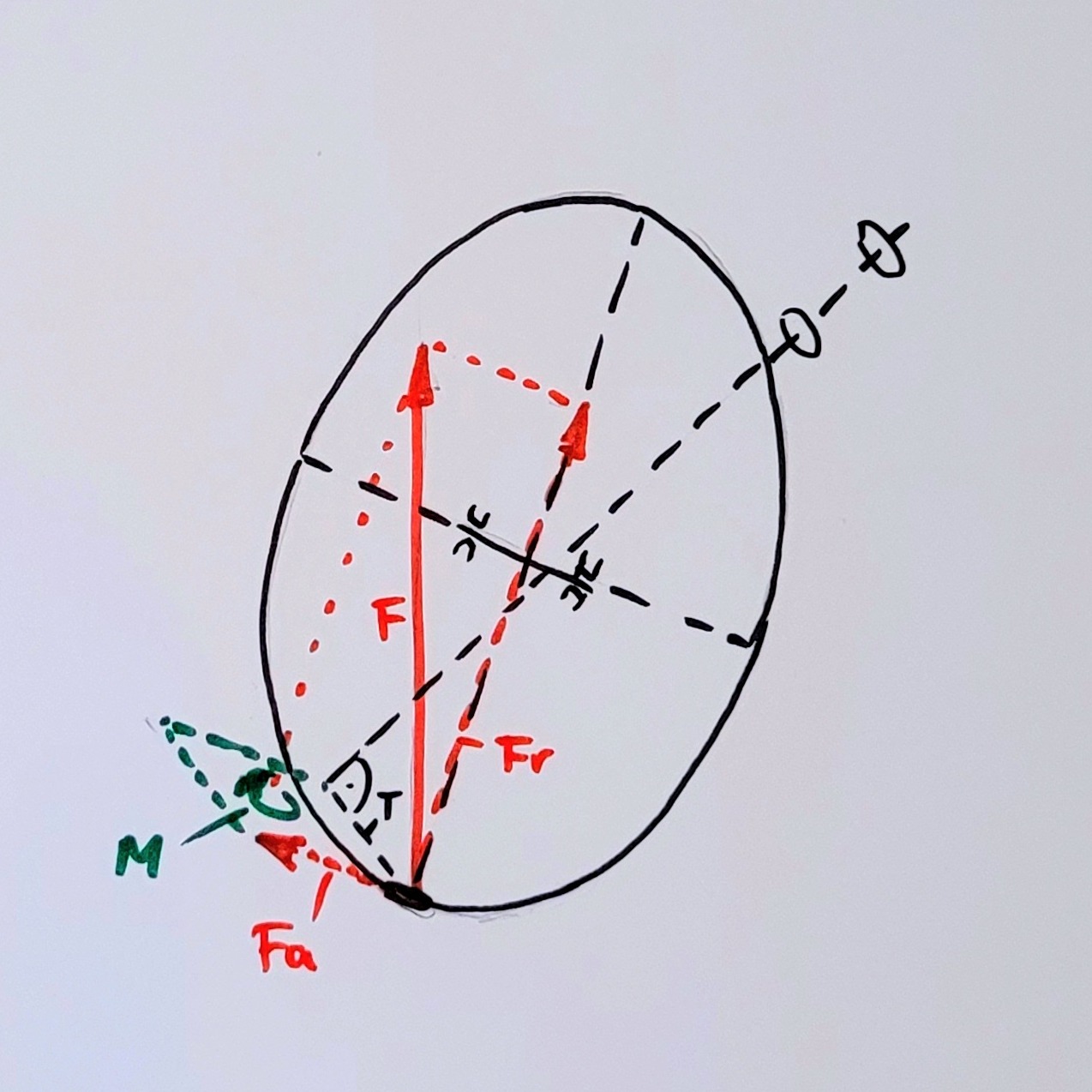
The torque M induces steers the front wheel inwards which moves the contact patch back under our center of gravity. We stabilize again instead of falling to the side.
Note that this effect is only dependent on trail and leaning angle, not on the head tube angle. It would occur with a vertical steering axis as well.
Wheel flop as described above comes in addition. It is dependent on an actual steering angle > 0° and it does not require any leaning of the bike. The front wheel leans inward when the handlebars are turned, the axial force Fa comes into play and creates an additional torque. This one also tends to increase the steering angle and make the bend more tight. The effect is dependent on:
- trail (again)
- an actual steering angle > 0°
- the head tube angle, which causes the front wheel to lean inward.
Note that the leverage changes with increasing steering angle, at some point it will be zero as the steering axis hits the tire contact patch.
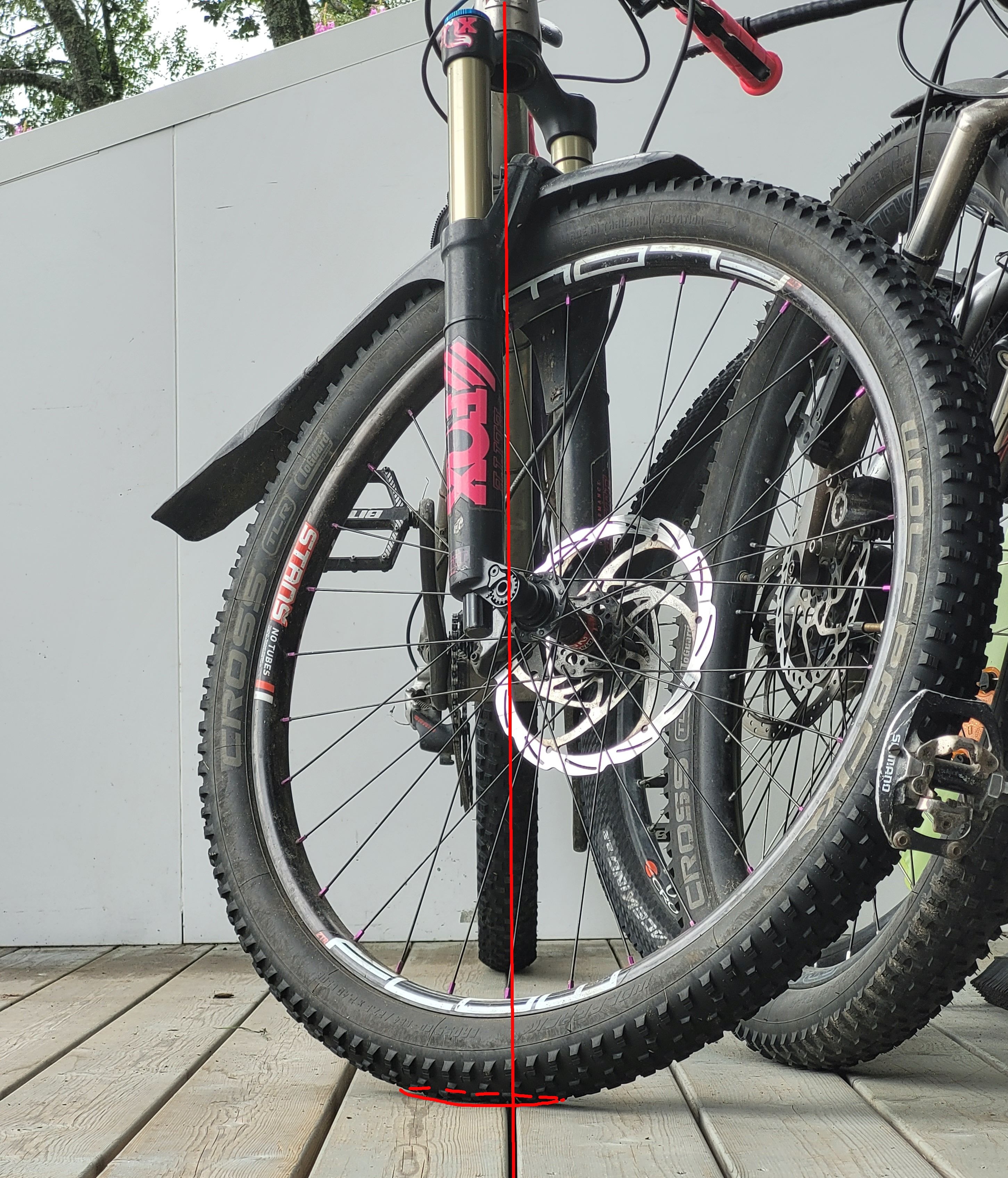
Steering axis and contact patch at a big steering angle
So we have two effects, and both tend to correct our imbalance. Unfortunately, wheel flop wants to keep the bike in the curved path as long as the handlebars are turned. Depending on bike geometry, this can be too much, and we feel like the bike wants to wander off we only lost balance by a little bit. We have to counter-steer at the handlebar, and the ride fells, well, floppy.
There are more factors at work, of course. A few candidates (there are probably more):
1. Front wheel trail also counteracts any quick turns at the handlebar and straightens the steering angle under braking forces. (I use the distance perpendicular to the steering axis, as this is the relevant value for torque feedback into the steering. It is called mechanical trail in Wikipedia.)
2. Gyroscopic forces on the wheels create torque counteracting any tilt movement perpendicular to rotation axis, e.g. steering input or leaning of bike. The effect is also proportional to v², and proportional to the moment of inertia of the wheel. Bigger, heavier wheels generate higher torque. There is almost no stabilizing effect at low speeds.
3. High load on the front wheel increases steering effort and can feel sluggish.
4. Tire friction: impedes turning the handlebar at very slow speeds. More importantly, it creates a torque to follow the tire’s “natural” curved track when the wheel is leaned to one side. This is heavily dependent on tire pressure, width and shape of cross section, carcass and tread design.
Back to the finding above. In a first comparison I took a look at six different bikes. See how mechanical trail and the two competing wheel flop values came out:
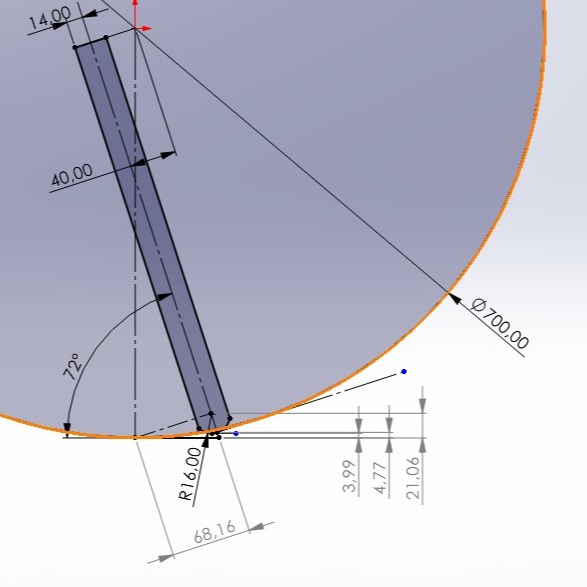
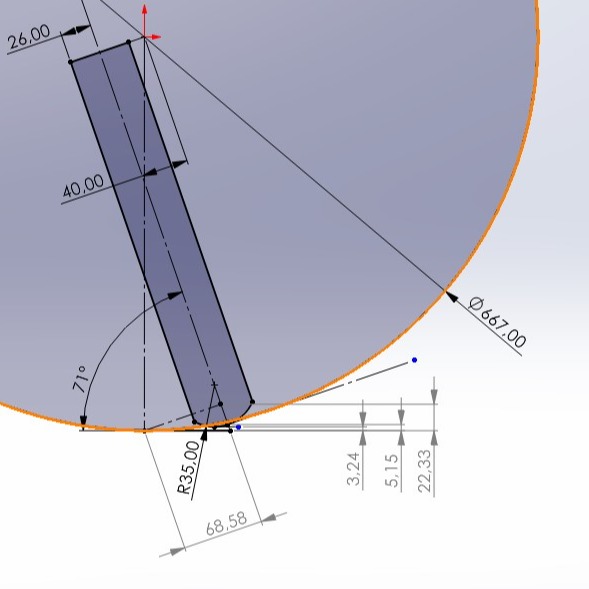
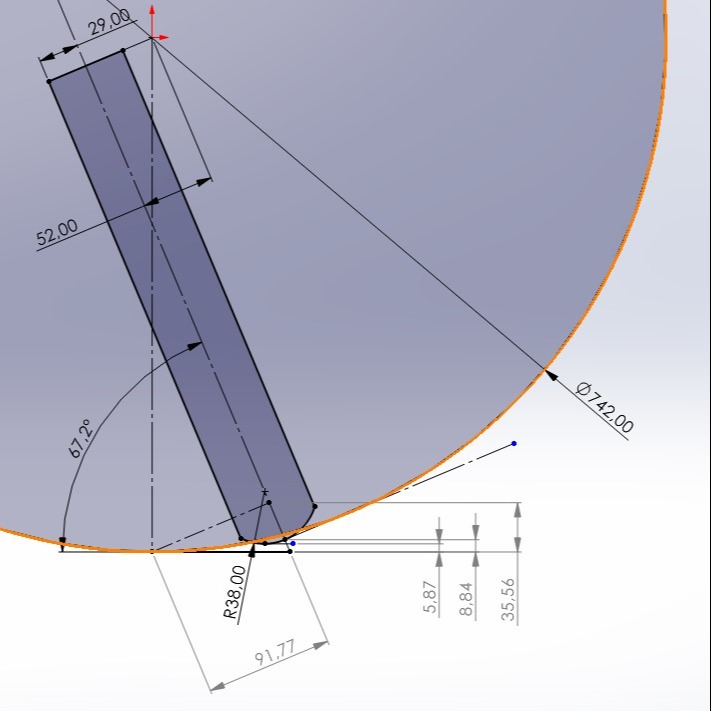
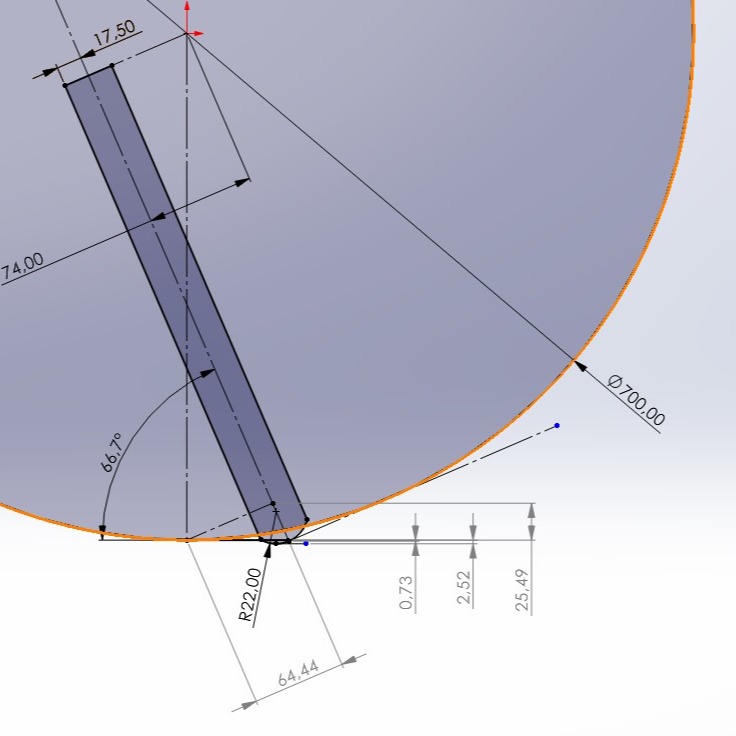
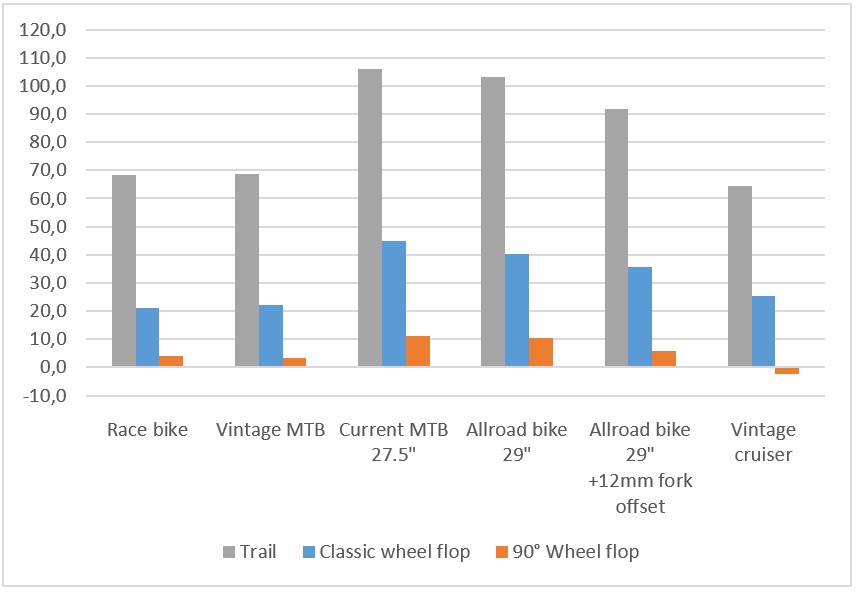
The race bike and the vintage MTB show striking similarities. This is not completely surprising, as fork rake and head tube angle are close. Both have very low amounts of 90° wheel flop. The MTB goes down to just 3,2mm due to the bigger curvature radius of the tire. The front of this bike lowers just about 3mm when turning the handlebar a full 90°. Classic wheel flop is around 21-22mm on these two.
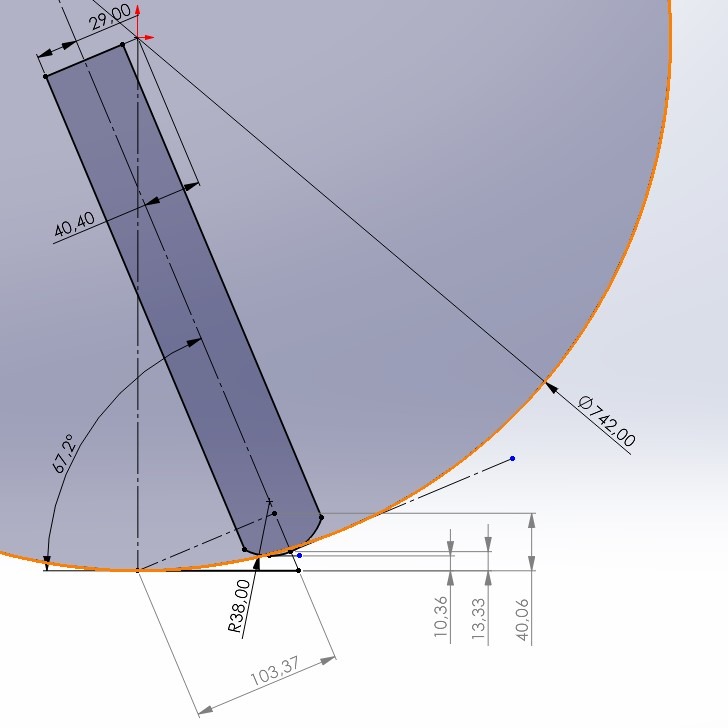
The “modern” geometries of the current MTB and the allroad bike jump to trail values over 100mm. Wheel flop values are much higher, more than 40mm classic and a 90° lowering of 10-11mm.
The current MTB and the allroad bike are two of my actual bikes, the results of conversions of rather old MTB frames with a redesign of the geometry. My riding experience is that the allroad bike feels more floppy than the MTB when climbing at slow speed, despite the slightly lower wheel flop values. Possible explanations: different weight distribution due to lower stack height and steeper seat tube angle on the allroad bike, wider handlebar on the MTB, higher inertia of the suspension fork compared to the lightweight rigid fork of the allroad bike.
The modern bikes with their larger trail and wheel flop values also have higher gyroscopic forces due to the larger wheels and wider, heavier tires, which also create more friction on the ground due to a bigger contact patch. So all parameters tend to create higher feedback forces in the steering system. Probably it is no coincidence that handlebar widths have grown massively with the geometry evolving in this direction.
Fork offset influences wheel flop. I took a look at the allroad bike with an increased fork offset, 52mm instead of the actual 40.4mm. This increases the wheel base of the bike by around 10mm, the trail is lowered around 11%, but the difference in 90° wheel flop is striking: it goes down from 10.4mm to 5.9mm, which is 43% less. The classic value dropped by just 11%.
Finally, we have the outlier, the vintage cruiser:
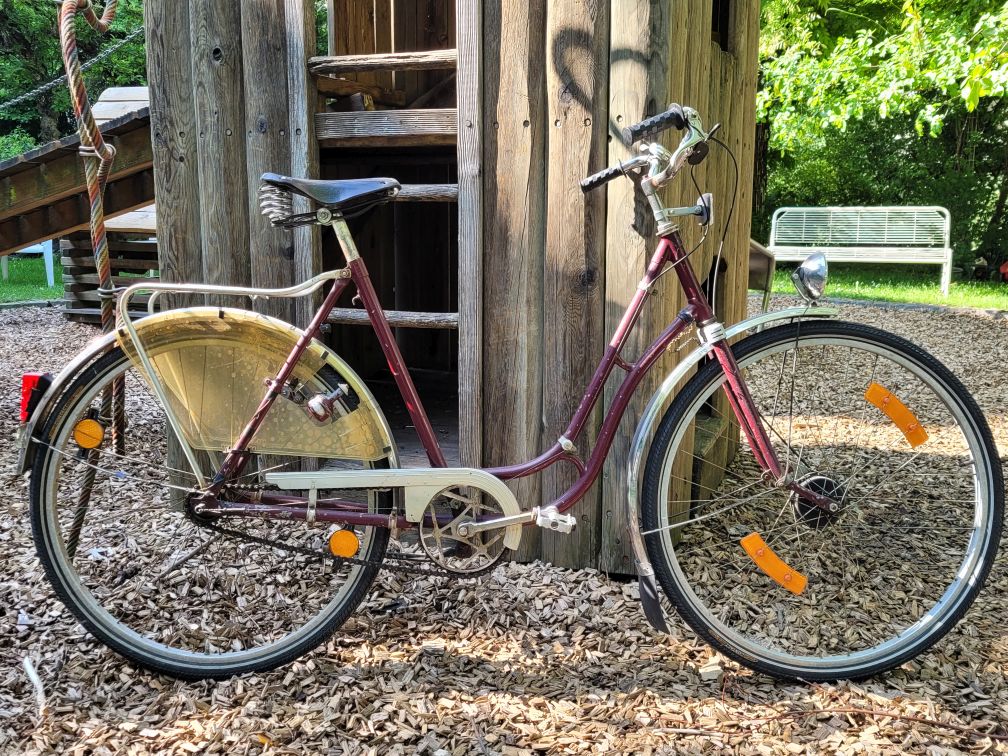
Sadly, I do not own this bike anymore. But measurements in this photo show a head tube angle of 66,7deg - quite progressive. Fork rake is in fact around 74mm, way bigger than on the other bikes.
And know what? Steering this bike feels super easy, intuitive, light-handed... the ideal bike to learn cycling. This rig rolls freehand where you want it to go, you can easily hold a straight line at almost standstill, or navigate the front wheel precisely.
All of this is achieved with a quite slack head tube angle, while maintaining a moderate front wheel trail of 64.4mm.
Wheel flop? With a 35mm tire, the front of this bike lifts 2.5mm when you turn the handlebar by 90°. On the contrary, the classic value of 25mm does not stand out.
Short wrap up:
1. Classic wheel flop and 90° wheel flop behave completely different.
2. Both numbers do not translate directly into the ride feel of the bike.
Looks like we do not understand fully yet what is going on here. Let us go back to the definition of the classic value. The formula describes the vertical travel of the lowest point of the tire when you turn the handlebar by 90° (imagine the bike fixed in space).
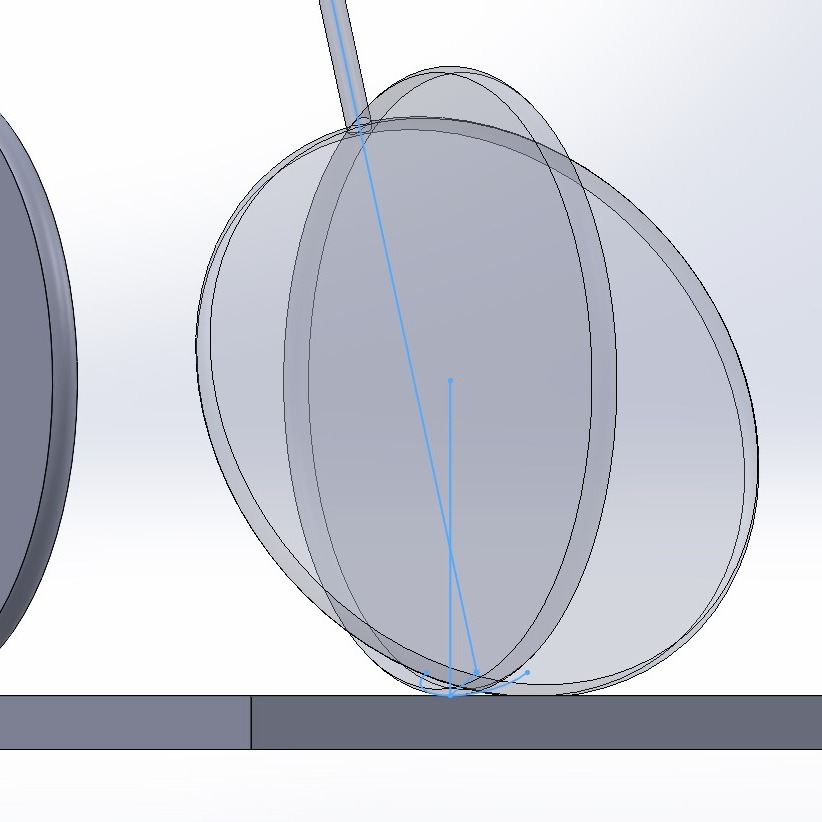
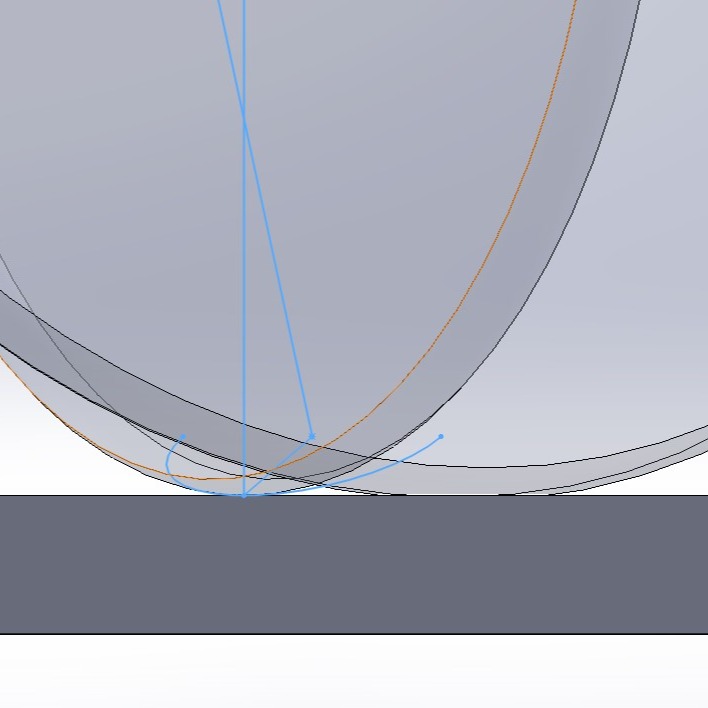
The ends of the half circle are indeed in the height indicated by the classic wheel flop formula. If you imagine the front wheel to be reduced to a tiny point (diameter and width both zero), then this would be the actual lowering of the front.
Now we do not ride super small front wheels. In the picture above you see the effect of the actual wheel, in this case, it is more than compensating the lowering at 90°.
But: actual riding does not incorporate a 90° turn at the handlebar (exceptions aside...). So is the 90° value actually valid for the feeling the bike will give us? What if the classic formula gives a better indication for the behavior at angles of, say, 20° or lower?
Ok. Let us take a breath and step into the 3D world. I wanted to create a diagram that shows wheel flop (i.e. lowering of the bike front) over steering angle, from -90° to 90°. The easiest way seemed to be a 3D CAD model of the setup where the handlebar can be turned to various angles for a measurement of the lowering distance. The vintage cruiser with its unique 2D wheel flop was my first candidate:
In this model the handlebar can be turned to defined angles to measure the drop distance, here visible as the floor plate moving a little bit. With some patience I got values for turning handlebars for 180°, from one end to the other. The result is quite interesting:
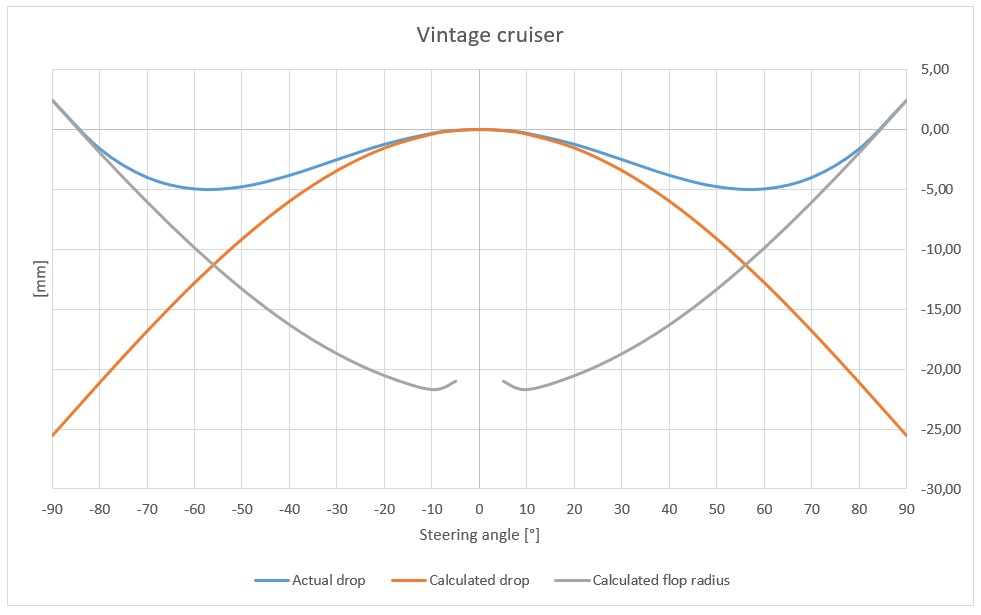
Turning the handlebar lowers the front of the bike, as the blue graph shows. The deepest drop (-5mm) occurs around 58°, then the bike lifts again. The 2D wheel flop value (+2.5mm) appears at +/- 90°, at the ends of this elegantly shaped curve. And it does not represent what is going on in the middle, where real riding occurs.
The orange line is the drop calculated from the classic wheel flop value (for wheel diameter zero) . At small angles it stays close to the actual curve, but then they are separating widely. Again, the classic wheel flop value appears at +/- 90°, here -25.5mm.
The gray line is a backward-calculated value. It shows the equivalent classic wheel flop radius for each angle. For angles < 20°, a 21mm number would describe this bike approximately. This is 82% of the classic wheel flop value.
Let us look at the allroad bike as another example:
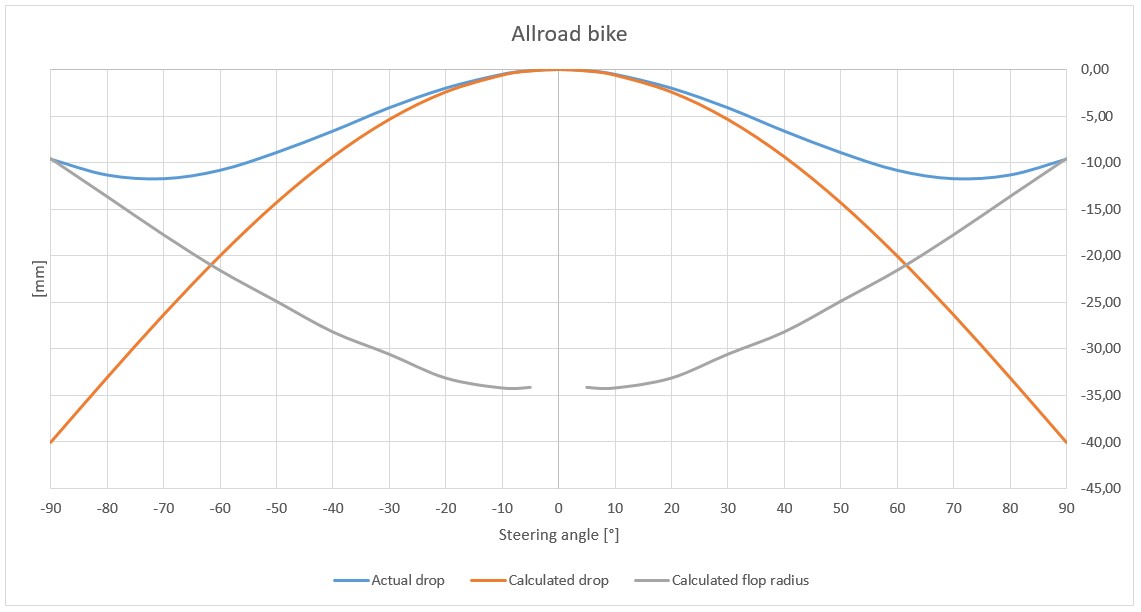
Very similar head tube angle, but shorter fork offset and a wider tire. Effects: visibly more drop (blue line), down to -12mm. The calculated drop radius suggests 34mm as a good value for small angles. In this case, this is 85% of the classic wheel flop value. And yes, this is 70% more than for the vintage cruiser.
Findings so far:
- Actual drop behaves not in a simple way
- The classic wheel flop value is valid at lower steering angles - if we reduce it by some degree.
Sensitivity on tire curvature
In the 90° drawings the influence of the tire width is apparent. But is this also true for smaller steering angles? I modeled the allroad bike with a fantasy fat bike tire with 68mm tire curvature radius, and with a narrow tire with 16mm curvature. All other parameters stayed the same - let us see:
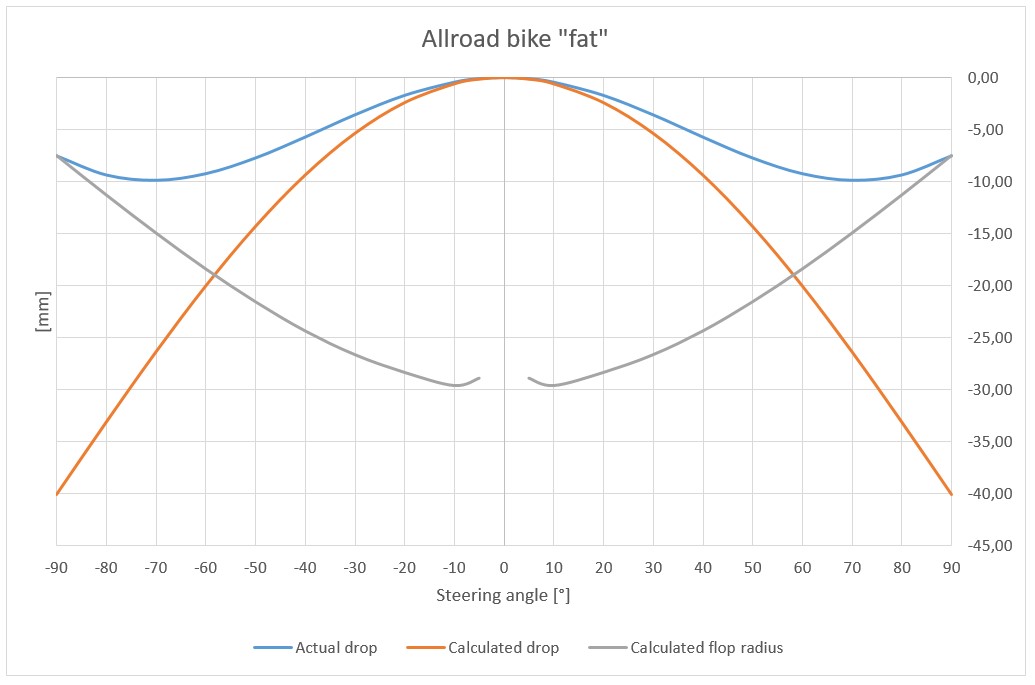
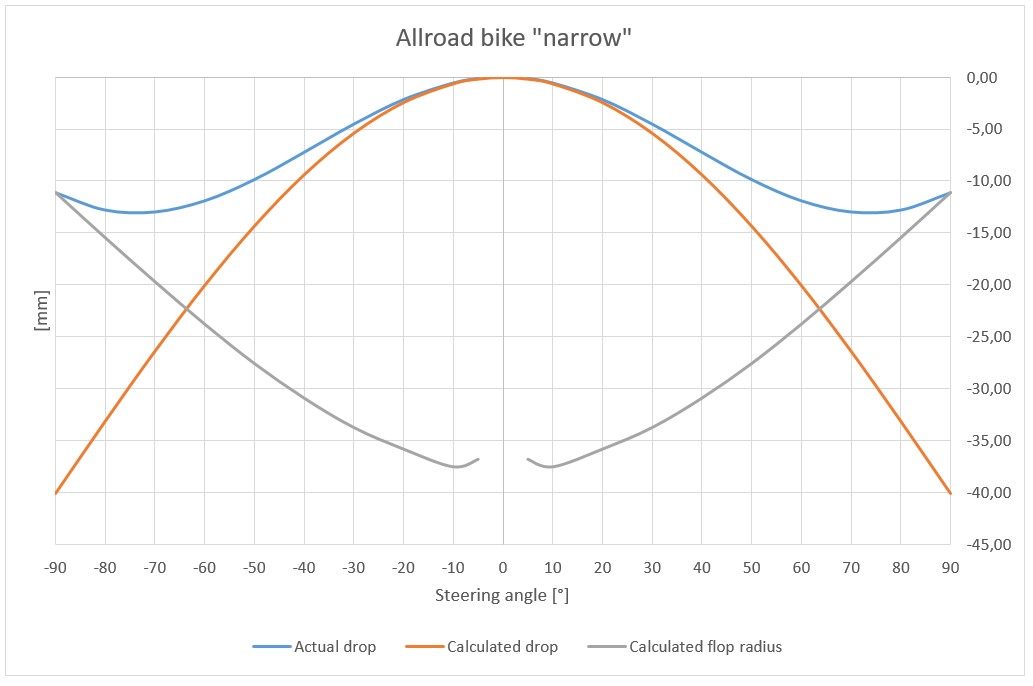
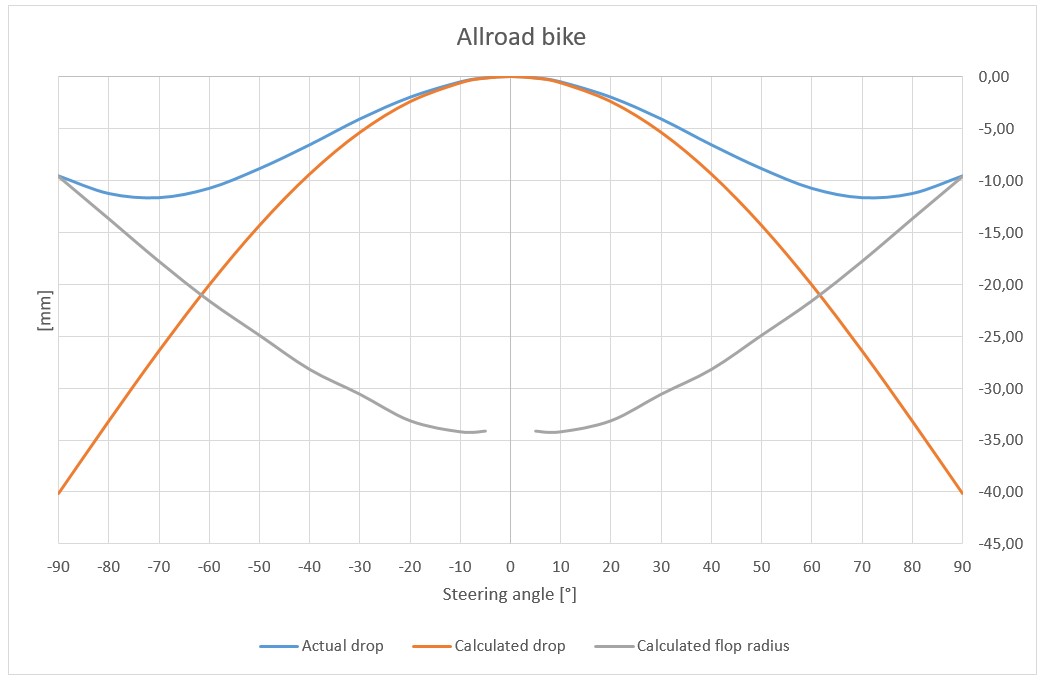
All setups have the same classic wheel flop (orange line, 40,1mm). The actual lowering depends visibly on tire width:
With the fat tire, the blue curve dips down to -10mm, but to -13mm in the narrow variant. Even more important is the calculated wheel flop radius at small angles, which describes the behavior for actual riding:
Fat: around 29mm / 70%
Baseline: 34mm / 85%
Narrow: 37mm / 92%
It looks like the classic wheel flop value is indeed a good approximation for really narrow tires. But a wide tire with a flat curvature reduces wheel flop substantially.
Speaking of approximation: Here is a diagram for smaller steering angles that shows how the reduced wheel flop compares to the measured lowering and to the calculated "classical" curve. Again, we look at the allroad bike:
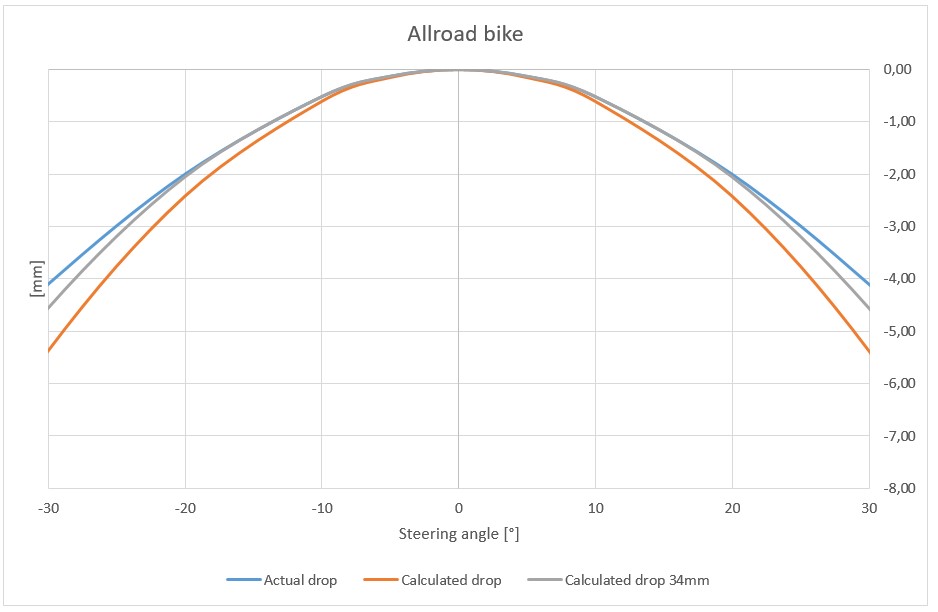
The calculated drop for a reduced wheel flop of 34mm / 85% is very close to the actual drop for steering angles smaller than 20°. So the 34mm value should describe the feeling adequately, and we are able to compare the other setups with this method as well.
Let us call this the Corrected wheel flop / Correction factor.
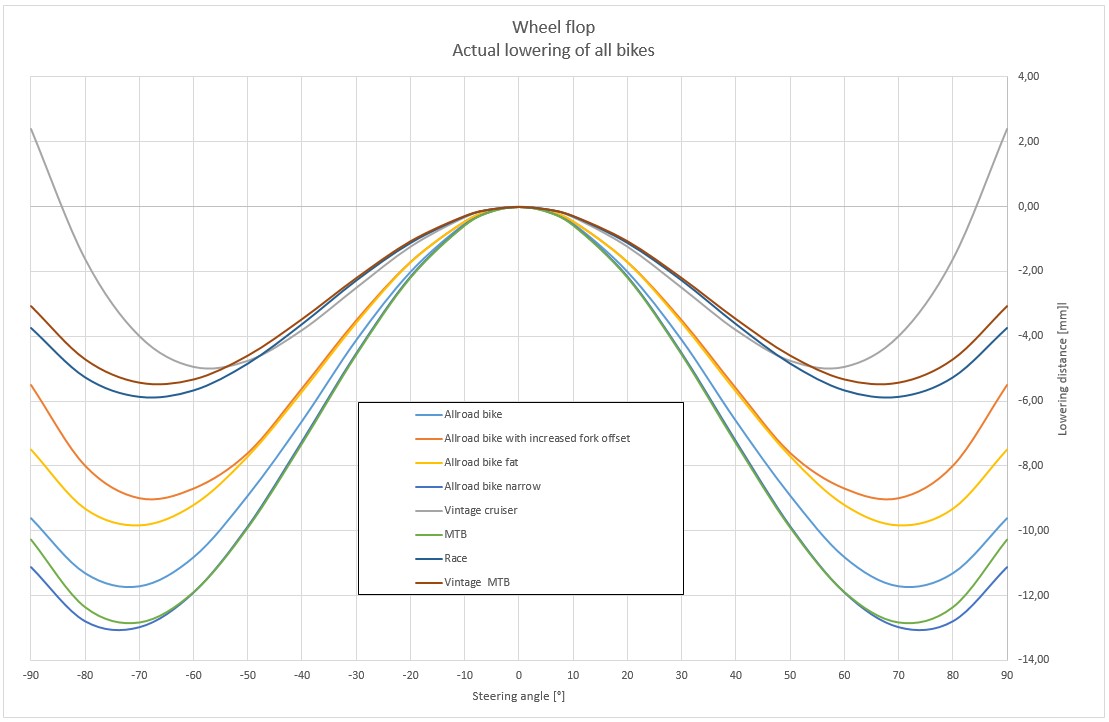
Firstly, let us look at the actual lowering of each bike:
For each bike I determined the corrected wheel flop and the correction factor:
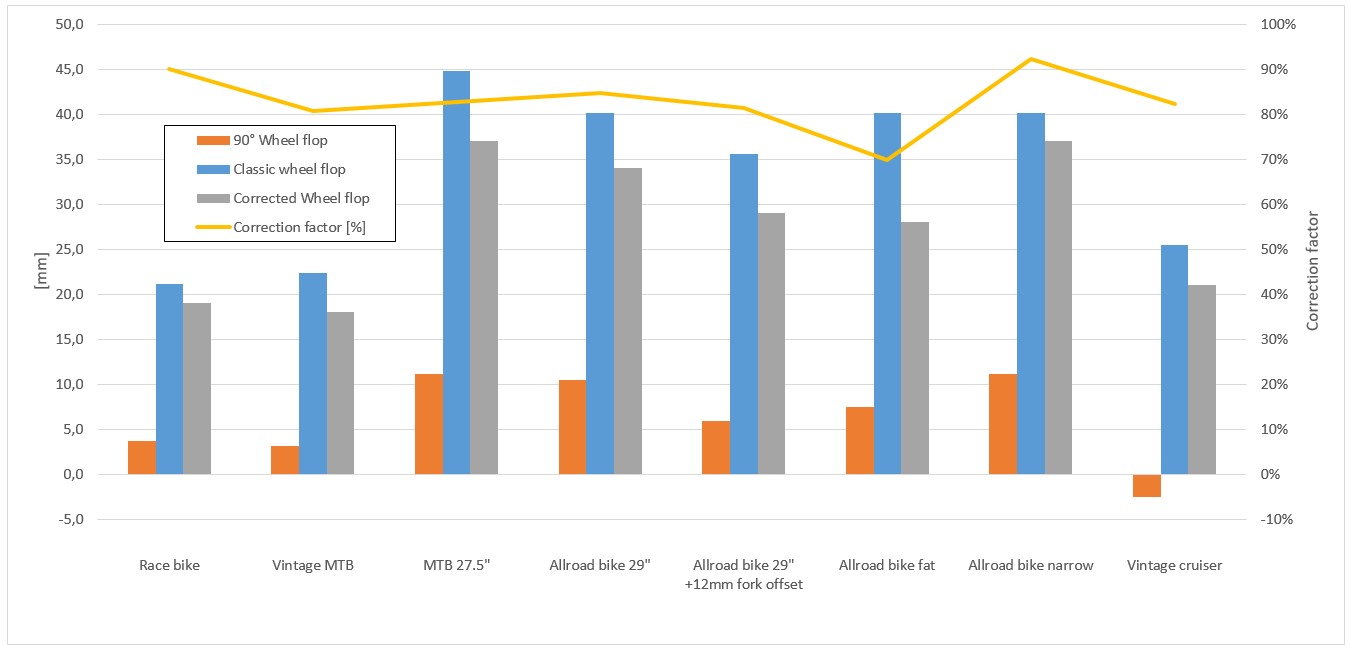
Here we are! Congrats that you made it until here.
The corrected wheel flop (grey bars) should give a good idea how much wheel flop is felt on each bike. The yellow line indicates how much correction is needed for the classic wheel flop value (blue bars). The classic value is too high in each case, and the deviation depends on the tire width. Fat tires lower in fact wheel flop, up to 30%.
The 90° wheel flop is unrelated to actual riding - it gives no indication of the behavior at low steering angles.
Modern mountain bike geometries with slack head tube angles and high trail have indeed corrected wheel flop values twice as big as found on traditional bikes. They ride differently, and probably they would not feel very nice with narrow tires and handlebars.
The classic wheel flop value can be used for a rough comparison of bikes, especially with narrow tires. When you want a more precise answer, 3D modelling gives a clue.
Questions or comments? Get in touch anytime.

AI Website Generator